
Skripsi-TBI
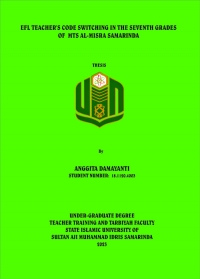
Efl Teacher’s Code Switching In The Seventh Grades Of MTs Al-Misra Samarinda
- Bagikan:


Anggita Damayanti. 2023. EFL Teacher’s Code Switching In The Seventh Grades of MTs Al-Misra Samarinda. Thesis, English Education Department, Teacher Training and Tarbiyah Faculty, State Islamic University Sultan Aji Muhammad Idris Samarinda. Thir research is under the guidance of Mr. Umar Fauzan, M. Pd., as the first advisor and Mrs. Nadia Sya’ya, M. Pd, M. TESOL., as the second adivisor.
Code switching is seen as a regular phenomena in today’s culture. The phenomena of switching languages may be noticed in the conversation of the English teaacher. Switching between English to Indonesian or different language can be utilized as a communication method while teaching English. Code switching is vital for language development because it allows ideas to be effectively transmitted from the teacher to the students. Based on this phenomena, the purposes of this research were to find out the types, the functions, and the reasons of EFL teacher used code switching in teaching and learning process in the seventh grades of MTs Al-Misra Samarinda.
This research used descriptive qualitative method. The subject of this research was EFL teacher in the seventh grades of MTs Al-Misra Samarinda. The data were collected using a video recorder in observation and interview. This research used the researcher itself as the main intrument. The data were analyzed using the Interactive Models of Miles, Huberman, and Saldana, then were validated using the source and technical triangulation.
Based on the result, the researcher found that there were three types of code switching used by EFL teacher in the seventh grades of MTs Al-Misra Samarinda, namely tag switcing or extra-sentential switching, intra-sentential switching, and inter-sentential swithing. Moreover, the researcher discovered that there were three functions of code switching used by EFL teacher, namely topic switch, affective function, and repetitive function. The researcher also discovered that there were ten out of eleven reasons used by the EFL teacher, namely talking about particular topic, quoting somebody else, being emphatic about something, interjection, repetition used for clarification, expressing group identity, lack of good equivalence of meaning, emphasize the message, and showing respect. Meanwhile, the well-know/popular English expression was not a reason for the teacher to use code swtiching.
Detail Information
| Item Type |
Skripsi
|
|---|---|
| Penulis |
Anggita DAMAYANTI - Personal Name
|
| Student ID |
18.1120.4003
|
| Dosen Pembimbing | |
| Penguji |
Rostanti Toba, M.Pd. - - Ketua Penguji
Dr. Umar Fauzan, M.Pd. - - Penguji 1 Nadia Sya'ya, M.Pd., M.TESOL - - Penguji 2 |
| Kode Prodi PDDIKTI |
88203
|
| Edisi |
Published
|
| Departement |
FTIK UINSI Samarinda
|
| Kontributor | |
| Bahasa |
English
|
| Penerbit | TBI-FTIK : Samarinda., 2023 |
| Edisi |
Published
|
| Subyek | |
| No Panggil | |
| Copyright |
Individu Penulis
|
| Doi |